England Cricket Team vs India National Cricket Team Timeline

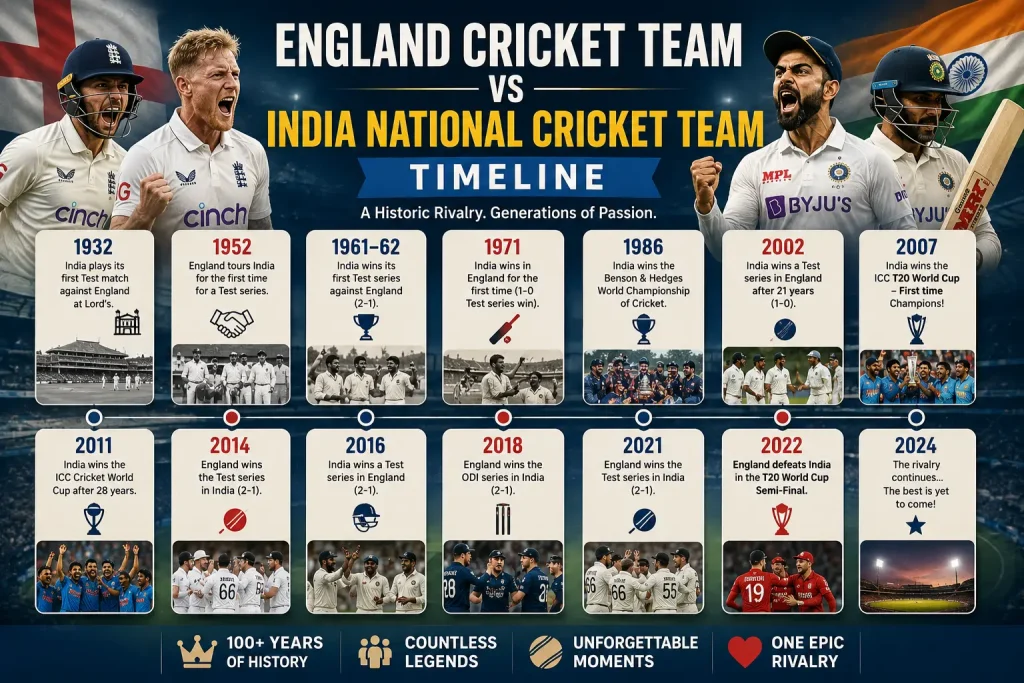
The England cricket team vs India national cricket team timeline stretches across more than nine decades and represents one of international cricket’s most important long-running rivalries. What began with India’s Test debut at Lord’s in 1932 has developed into a multi-format contest involving historic Test series, World Cup knockouts, dramatic ODI finals, T20 World Cup battles, record-breaking individual performances, and frequent changes in momentum.
The rivalry is particularly interesting because the balance of power has changed considerably over time. England controlled many of the early encounters, while India gradually became far more competitive at home and eventually learned how to win major series in English conditions. The arrival of ODI cricket added famous World Cup meetings, while T20 cricket created an entirely new chapter featuring Yuvraj Singh’s six sixes, knockout victories, and high-scoring modern contests.
The story continued through 2025 and 2026. India and England drew a dramatic five-Test series in England 2-2 in 2025, India defeated England in another T20 World Cup semi-final in March 2026, and England responded strongly during India’s white-ball tour of England in July 2026.
England vs India Cricket Rivalry at a Glance
| Category | England | India |
|---|---|---|
| Test cricket origin | One of Test cricket’s original nations | Test debut against England in 1932 |
| First England vs India Test | 1932 | 1932 |
| First Test series win in the rivalry | England | India first won in 1961-62 |
| India’s first Test series win in England | — | 1971 |
| Major ODI rivalry highlight | 1987 World Cup semi-final | 1983 World Cup semi-final |
| Famous 2000s ODI moment | NatWest Final opponent | Won 2002 NatWest Final |
| T20 World Cup titles through 2026 | Two | Three |
| Main modern formats | Tests, ODIs, T20Is | Tests, ODIs, T20Is |
| Rivalry character | Pace, depth, aggressive batting | Spin, adaptability, batting depth, pace evolution |
The rivalry cannot be understood through one format alone. Test cricket created its history, ODI cricket added major tournament drama, and T20Is transformed England versus India into one of the most commercially significant fixtures in the modern game.
1932: India Plays Its First Test Against England
The India vs England cricket history officially began on June 25, 1932, at Lord’s in London. This was not simply India’s first Test against England; it was India’s first Test match as an international Test-playing nation.
CK Nayudu captained the Indian team, while England won the one-off Test by 158 runs. The result reflected England’s greater experience at the time, but India’s performance demonstrated that the new Test side possessed genuine talent.
For India, the importance of the match extended far beyond the scorecard. It marked the beginning of a journey that would eventually transform the country into one of the most influential forces in world cricket. The first match therefore remains the natural starting point of every England vs India cricket timeline.
1933-34: England Tours India
England travelled to India for a three-Test series in 1933-34, giving Indian supporters their first opportunity to watch the two national teams compete in a Test series on Indian soil.
England won the series 2-0, with one Test drawn. During this early period, England generally had the stronger and more experienced side, while India was still developing the structures, players, and competitive experience required for sustained success in Test cricket.
The series helped establish what would eventually become one of cricket’s most frequently repeated international contests.
1946: International Cricket Resumes After the War
India toured England again in 1946 following the interruption caused by the Second World War. England won the three-match Test series 1-0.
India had improved since its earliest international appearances, but defeating England in English conditions remained extremely difficult. Swing, seam movement, unfamiliar weather, and England’s experience in home conditions created challenges that would remain central to the rivalry for decades.
1952: India’s First Test Victory
One of the first great turning points came during England’s 1951-52 tour of India.
In Madras, now Chennai, India defeated England to register its first-ever Test victory, not merely its first Test victory over England. The five-Test series finished 1-1.
This result was historically significant because India had been playing Test cricket for approximately two decades without recording a victory. Beating England demonstrated that India was beginning to move beyond simply participating at Test level.
The achievement laid important foundations for what followed in the 1960s and 1970s.
1961-62: India Wins Its First Test Series Against England
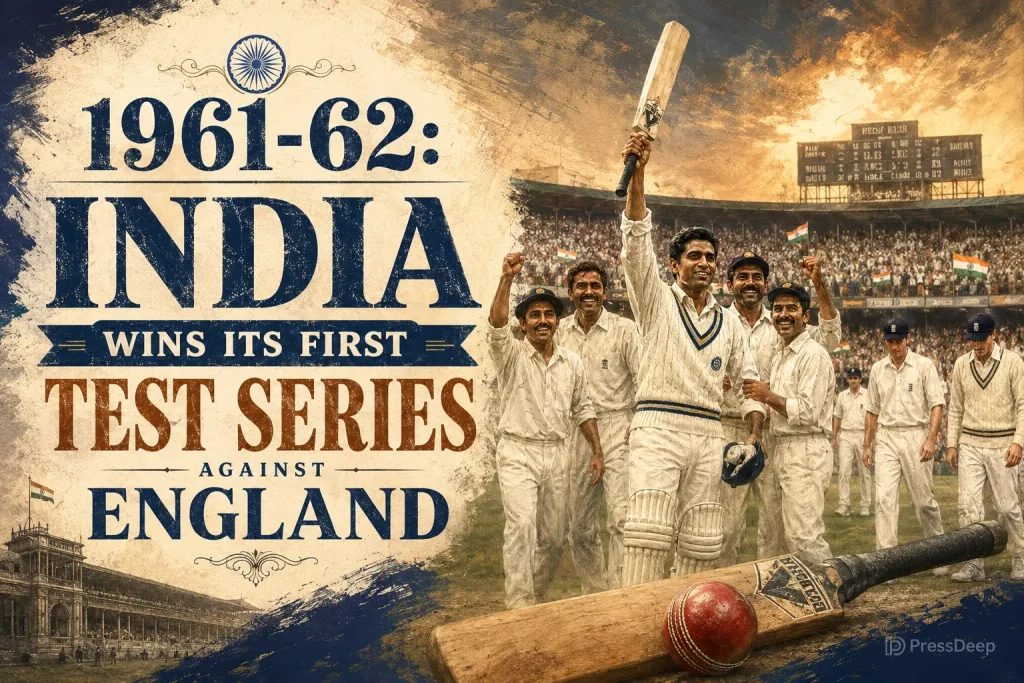
India’s development became clearer during England’s tour of India in 1961-62.
India won the five-Test series 2-0, recording its first Test series victory against England.
The result represented a major shift in the India England cricket rivalry. England remained formidable, particularly at home, but India was becoming increasingly difficult to defeat in subcontinental conditions.
Spin bowling, patience, and familiarity with Indian pitches became important parts of India’s home advantage.
1967: England Reasserts Control at Home
India’s progress at home did not immediately translate into success in England.
During the 1967 tour, England won all three Tests to complete a 3-0 series victory. The result highlighted one of the central themes of the rivalry: success in home conditions was considerably easier than succeeding overseas.
For India, winning a series in England remained a major unfinished objective.
That changed four years later.
1971: India’s Historic First Test Series Win in England
The 1971 tour remains one of the most important chapters in the England cricket team vs India national cricket team timeline.
Led by Ajit Wadekar, India won the three-Test series 1-0. After draws in the first two Tests, India defeated England at The Oval to secure its first Test series victory on English soil.
Bhagwat Chandrasekhar produced a decisive bowling performance in England’s second innings, taking 6 for 38 and helping create a manageable target for India.
The victory was enormously significant. India had finally demonstrated that it could defeat England not only on Indian pitches but also in England.
For Indian cricket, 1971 became a symbol of growing overseas confidence.
1974: The Rivalry Enters ODI Cricket
The 1970s brought another important development: One Day International cricket.
India and England met in their first ODI series against each other during India’s 1974 tour of England. The shorter format would eventually add an entirely different personality to the rivalry.
Test matches focused on patience, technique, and long-term tactical battles. ODI cricket increased the importance of scoring rates, limited-overs strategy, field restrictions, and finishing ability.
Over the following decades, India and England would meet in several major World Cup and tournament matches that became as memorable as their Test encounters.
1983: India Beats England in the World Cup Semi-Final
The 1983 Cricket World Cup produced one of the defining early ODI encounters between the teams.
England faced India in the semi-final at Old Trafford. England scored 213, while India successfully chased the target with six wickets remaining.
India’s victory sent Kapil Dev’s team into the World Cup final, where it famously defeated the West Indies to become world champion for the first time.
This made the England semi-final an essential part of India’s 1983 World Cup story.
For the rivalry itself, the match proved that India could defeat England in a major global knockout game as well as in bilateral cricket.
1986: India Dominates a Test Series in England
India returned to England in 1986 and produced one of its finest overseas Test performances.
Under Kapil Dev, India won the three-Test series 2-0. Victories at Lord’s and Headingley gave India an unassailable advantage before the final match ended in a draw.
The result remains one of India’s most convincing Test series performances in England.
Dilip Vengsarkar played a major role with the bat, while India’s bowling attack adapted successfully to English conditions.
The significance of the 1986 victory was clear: 1971 was no longer an isolated achievement. India had now won a Test series in England for the second time.
1987: England Gets World Cup Revenge
Four years after India eliminated England from the 1983 World Cup, the teams met again in a World Cup semi-final.
This time, England won.
At Wankhede Stadium in Mumbai, Graham Gooch scored 115 as England made 254 for 6. India was then dismissed for 219, giving England a 35-run victory and a place in the final.
The two World Cup semi-finals created an interesting early pattern:
| World Cup | Stage | Winner | Margin |
|---|---|---|---|
| 1983 | Semi-final | India | 6 wickets |
| 1987 | Semi-final | England | 35 runs |
Each side had now ended the other’s World Cup campaign on a major stage.
1990: Sachin Tendulkar’s First Test Century
The 1990 Test series introduced a name that would become central to Indian cricket for more than two decades.
At Old Trafford in Manchester, a teenage Sachin Tendulkar scored an unbeaten 119 to help India save the second Test.
England ultimately won the three-Test series 1-0, but Tendulkar’s innings became far more memorable than the overall result for many Indian fans.
The rivalry during the 1990s featured players such as:
- Sachin Tendulkar
- Mohammad Azharuddin
- Rahul Dravid
- Sourav Ganguly
- Anil Kumble
- Graham Gooch
- Mike Atherton
- Alec Stewart
- Darren Gough
The decade also witnessed the emergence of a stronger Indian batting generation that would play an important role in making the rivalry more balanced during the 2000s.
1996: Ganguly and Dravid Arrive in Test Cricket
India’s 1996 tour of England became famous for the emergence of Sourav Ganguly and Rahul Dravid.
Ganguly scored a century on Test debut at Lord’s, while Dravid narrowly missed a century in the same match. Both would later become major figures in Indian cricket.
England won the series 1-0, but India’s new generation offered clear evidence that the country’s batting future was exceptionally strong.
Tendulkar, Ganguly, and Dravid would become central characters in future England vs India contests.
2002: The Famous NatWest Final at Lord’s
The 2002 NatWest Series final remains one of the most celebrated matches in India vs England ODI history.
England batted first at Lord’s and scored 325 for 5, powered by centuries from Marcus Trescothick and Nasser Hussain.
India appeared to be in serious trouble during the chase before Yuvraj Singh and Mohammad Kaif rebuilt the innings. Kaif finished unbeaten on 87 as India reached 326 for 8 with three balls remaining, winning by two wickets.
Sourav Ganguly’s celebration from the Lord’s balcony became one of the most recognizable images of Indian cricket from that era.
The match was important because it represented a new Indian attitude in limited-overs cricket. Large targets no longer appeared impossible, and younger players were increasingly capable of finishing high-pressure matches.
2007: India Wins Another Test Series in England
Twenty-one years after the 1986 triumph, India won another Test series in England.
India took the three-match series 1-0. The victory strengthened the reputation of a generation featuring players such as Rahul Dravid, Sachin Tendulkar, Sourav Ganguly, VVS Laxman, Anil Kumble, and Zaheer Khan.
The result also showed that India had developed enough depth to compete successfully in challenging overseas conditions.
2007: Yuvraj Singh Hits Six Sixes
The inaugural ICC World Twenty20 created one of the most famous moments in the entire India-England rivalry.
During the India vs England match in Durban, Yuvraj Singh hit Stuart Broad for six sixes in one over. He reached fifty from only 12 balls, establishing a record for the fastest men’s T20I half-century that stood for years.
India won the match by 18 runs and later became the inaugural T20 world champion.
This moment permanently connected England and India with the early history of T20 cricket.
It also demonstrated how dramatically the rivalry was changing. A contest that began with traditional Test cricket in 1932 was now producing some of the most explosive batting ever seen internationally.
2011: England Dominates the Test Series
England enjoyed one of its most convincing modern Test victories against India in 2011.
India arrived in England with a highly experienced batting line-up, but England dominated the four-Test series and won 4-0.
The result demonstrated how quickly momentum could change between these teams. Even powerful Indian sides could struggle against England’s pace and movement in home conditions.
It also helped England establish itself as one of the leading Test sides of that period.
2012-13: England Wins a Test Series in India
One of England’s most significant achievements in the rivalry came during its 2012-13 tour of India.
After losing the opening Test, England recovered and won the four-match series 2-1.
Winning a Test series in India is difficult for any visiting side, largely because Indian conditions traditionally favor home batters and spin bowlers.
England’s ability to reverse the series after losing the first match made the victory especially notable.
2013: India Beats England in the Champions Trophy Final
India and England met in another major ICC knockout game during the 2013 Champions Trophy final at Edgbaston.
Rain reduced the match to 20 overs per side. India scored 129 for 7 before restricting England to 124 for 8, winning by five runs.
The narrow victory gave India the Champions Trophy and created another memorable tournament chapter in the rivalry.
By this stage, England and India had faced each other in major World Cup semi-finals, a famous bilateral ODI final, and an ICC tournament final.
2014: England Wins 3-1 at Home
India began the 2014 Test series in England competitively and recorded a famous victory at Lord’s.
However, England responded strongly and eventually won the five-Test series 3-1.
The series highlighted an issue that had repeatedly appeared throughout India’s cricket history: maintaining batting consistency against the moving ball over an entire English tour.
2016-17: India Dominates England at Home
England travelled to India in 2016 for a five-Test series.
After the opening Test ended in a draw, India controlled the rest of the contest and won the series 4-0.
Virat Kohli was central to India’s success, while Ravichandran Ashwin and Ravindra Jadeja provided major threats with the ball.
The series reflected India’s growing dominance at home during the Kohli era.
2018: England Wins Another Home Test Series
The 2018 Test series was more competitive than the final score might suggest, but England ultimately won 4-1.
Virat Kohli produced a strong individual batting series after struggling during India’s previous tour of England in 2014. England, however, proved more consistent across decisive moments.
Players such as Joe Root, James Anderson, Ben Stokes, Virat Kohli, and Jasprit Bumrah became central figures in the modern phase of the rivalry.
2019 Cricket World Cup: England Hands India Its First Defeat
England and India met during the league stage of the 2019 ODI World Cup in Birmingham.
England won by 31 runs, handing India its first defeat of that World Cup campaign.
The result was particularly important for England because the hosts needed strong performances late in the group stage to secure their path toward the semi-finals.
England eventually won the 2019 World Cup, while India was eliminated by New Zealand in the semi-final.
2021-22: One Test Series Across Two Years
The 2021 Test series in England became one of the most unusual chapters in the rivalry.
India led the series 2-1 after four Tests, but the fifth match was postponed and eventually played at Edgbaston in July 2022.
England won the rescheduled Test, meaning the five-match series ultimately finished 2-2.
The extended timeline made the series particularly unusual. A contest that began under one set of circumstances concluded almost a year later with changes in leadership and team combinations.
2022: England Crushes India in the T20 World Cup Semi-Final
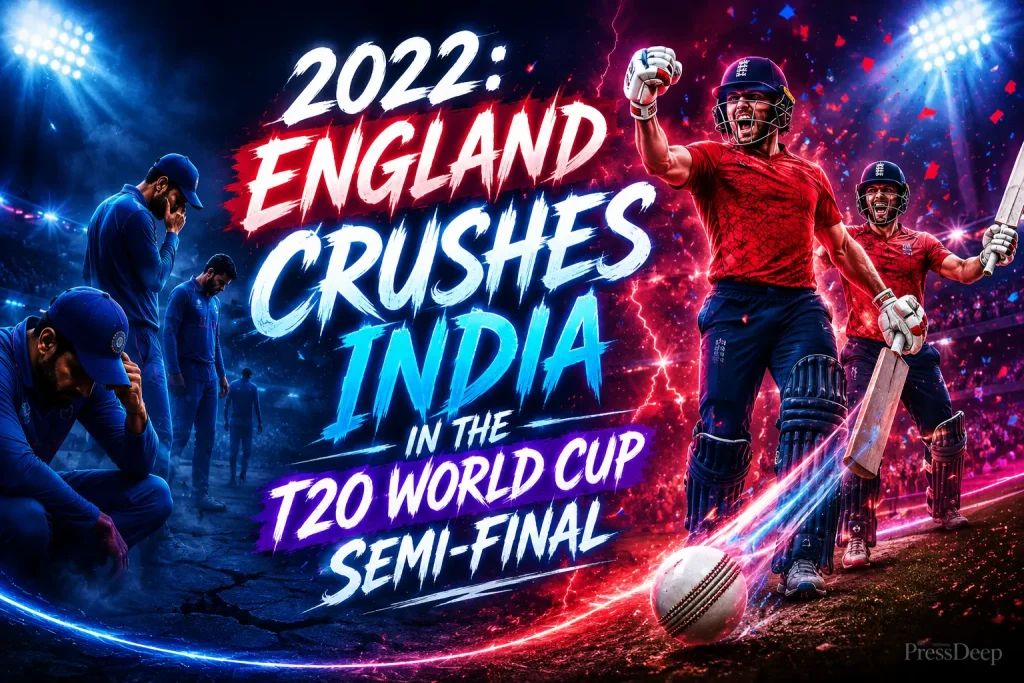
England and India met in the semi-final of the 2022 ICC Men’s T20 World Cup at Adelaide Oval.
India scored 168 for 6, but England’s openers completely controlled the chase. Alex Hales made an unbeaten 86 and Jos Buttler an unbeaten 80 as England reached 170 without losing a wicket.
England won by 10 wickets and advanced to the final, where it later won the tournament.
For India, the result was one of its most disappointing T20 World Cup defeats.
For England, it was one of the team’s most dominant knockout performances.
2024: India Gets Its T20 World Cup Revenge
Two years later, India and England met again in a T20 World Cup semi-final.
This time, the result was reversed.
India scored 171 for 7 in Guyana before dismissing England for 103. India won by 68 runs, with Axar Patel named Player of the Match and Kuldeep Yadav also playing an important role with the ball.
India then defeated South Africa in the final to win the 2024 T20 World Cup.
The 2022 and 2024 semi-finals created an intriguing short-format rivalry:
- 2022: England eliminated India.
- 2024: India eliminated England.
- 2026: The teams would meet in the semi-finals yet again.
2024 Test Series: India Responds After Losing the Opener
England’s 2024 Test tour of India began with a major surprise when England won the opening match in Hyderabad.
India responded decisively.
The hosts won the next four Tests to claim the five-match series 4-1. The series featured significant performances and milestones, including major contributions from Yashasvi Jaiswal and India’s bowling attack.
The comeback demonstrated India’s strength in home Test cricket and its ability to recover quickly after falling behind in a long series.
2025: India Dominates England in White-Ball Cricket at Home
England toured India in early 2025 for five T20Is and three ODIs.
India won the T20I series 4-1. Abhishek Sharma produced a spectacular 135 in the final match as India completed a dominant series victory.
The ODI series was even more one-sided. India won all three matches to complete a 3-0 sweep, including a 142-run victory in the final ODI at Ahmedabad.
These results strengthened India’s recent white-ball record against England heading into another major year of competition.
2025: The Anderson-Tendulkar Trophy Ends 2-2
The five-Test contest in England during the summer of 2025 added another dramatic chapter to the England vs India Test series history.
England won the opening Test at Headingley, India answered with victory at Edgbaston, and England moved ahead again at Lord’s. The fourth Test at Old Trafford ended in a draw, leaving India needing victory in the final match at The Oval to level the series.
India won that fifth Test by just six runs, producing one of the narrowest and most dramatic finishes in the history of the rivalry.
The final result was 2-2, meaning neither side could claim the series despite five Tests of changing momentum.
The series also represented the beginning of a new era in India’s Test team, with Shubman Gill leading a younger side through a demanding English tour.
2026: India and England Meet in a Third Consecutive T20 World Cup Semi-Final
By 2026, India versus England had developed into something unusual in T20 World Cup cricket: a recurring semi-final fixture.
After meeting in the last four in 2022 and 2024, the teams faced each other again at Wankhede Stadium in Mumbai on March 5, 2026.
India made 253 for 7, led by Sanju Samson’s 89 from 42 balls. England responded aggressively, with Jacob Bethell scoring 105 from 48 deliveries, but finished on 246 for 7.
India won by seven runs and advanced to the final. The match produced 499 combined runs, making it one of the most extraordinary high-scoring contests in T20 World Cup history.
The three successive semi-final meetings tell their own story:
| T20 World Cup | Venue | Winner | Margin |
|---|---|---|---|
| 2022 | Adelaide | England | 10 wickets |
| 2024 | Guyana | India | 68 runs |
| 2026 | Mumbai | India | 7 runs |
Few international rivalries have produced such a concentrated series of knockout meetings in the same tournament.
2026: England Strikes Back in the Home White-Ball Series
The rivalry continued only months after the T20 World Cup semi-final when India toured England for five T20Is and three ODIs in July 2026.
The opening T20I was abandoned without a result, but England then controlled the remainder of the series, winning the next four matches and taking the series 4-0. In the fifth T20I at Southampton, England scored 257 for 3 before restricting India to 201 for 8 to win by 56 runs.
The ODI series was more competitive. India won the opener at Edgbaston by six wickets, but England responded by winning the second and third matches to claim the series 2-1.
These results provided another reminder of one of the rivalry’s oldest patterns: home conditions frequently play an important role, and momentum can change quickly between tours.
England vs India Key Timeline
| Year | Major Event | Significance |
|---|---|---|
| 1932 | India plays first Test at Lord’s | Beginning of India’s Test history |
| 1933-34 | England tours India | First Test series between them in India |
| 1952 | India beats England in Madras | India’s first-ever Test victory |
| 1961-62 | India wins 2-0 | First Test series victory over England |
| 1971 | India wins 1-0 in England | First Test series win in England |
| 1974 | ODI rivalry begins | New format enters the rivalry |
| 1983 | India beats England in World Cup semi-final | India reaches eventual title-winning final |
| 1986 | India wins Test series 2-0 in England | Second Test series triumph in England |
| 1987 | England beats India in World Cup semi-final | England wins by 35 runs |
| 1990 | Tendulkar scores first Test hundred | Beginning of an iconic career milestone |
| 2002 | India wins NatWest Final | Famous 326-run chase at Lord’s |
| 2007 | India wins Test series in England | First since 1986 |
| 2007 | Yuvraj hits six sixes | Iconic T20 World Cup moment |
| 2012-13 | England wins Test series in India | Rare modern away series triumph |
| 2013 | India wins Champions Trophy final | India wins by five runs |
| 2016-17 | India wins Test series 4-0 | Home dominance |
| 2021-22 | Test series ends 2-2 | Final Test played a year later |
| 2022 | England wins T20 WC semi-final | Ten-wicket victory |
| 2024 | India wins Test series 4-1 | India recovers after losing opener |
| 2024 | India wins T20 WC semi-final | 68-run victory |
| 2025 | India wins home T20I series 4-1 | Strong white-ball performance |
| 2025 | India wins home ODI series 3-0 | Complete ODI sweep |
| 2025 | England Test series ends 2-2 | Dramatic Oval finale |
| 2026 | India wins T20 WC semi-final | Seven-run thriller in Mumbai |
| 2026 | England wins home T20I series 4-0 | Four wins after opening no-result |
| 2026 | England wins ODI series 2-1 | Latest white-ball chapter |
How the Rivalry Has Changed Across Formats
Test Cricket Built the Rivalry
For decades, the England vs India contest was primarily a Test rivalry.
England initially held the advantage because of experience and its ability to exploit home conditions. India gradually developed a powerful home record through spin bowling and stronger batting before improving overseas.
The Test rivalry increasingly became a contest between contrasting skills:
- English seam and swing against Indian batting
- Indian spin against English batters
- England’s traditional strength in home conditions
- India’s growing fast-bowling depth
- Long tactical battles between elite captains
Modern Test series between the teams have become far more balanced than those of the early decades.
ODI Cricket Added Tournament Pressure
The ODI rivalry created moments that could not occur in bilateral Tests.
World Cup semi-finals in 1983 and 1987, the 2002 NatWest final, and the 2013 Champions Trophy final gave England versus India genuine knockout history.
ODI encounters have often featured dramatic chases and major tournament consequences, making the format an important part of the rivalry’s identity.
T20 Cricket Changed Everything Again
T20 cricket created the fastest-moving chapter.
Yuvraj Singh’s six sixes in 2007 established an iconic early moment, but the rivalry became even more significant once India and England developed into two of the world’s strongest T20 teams.
Their three successive T20 World Cup semi-final meetings in 2022, 2024, and 2026 demonstrate just how important the matchup has become.
Iconic Players in the England vs India Rivalry
Different generations have produced different defining figures.
Legendary Indian Players
Important Indian names associated with the rivalry include:
- CK Nayudu
- Vijay Hazare
- Sunil Gavaskar
- Kapil Dev
- Dilip Vengsarkar
- Sachin Tendulkar
- Mohammad Azharuddin
- Rahul Dravid
- Sourav Ganguly
- Anil Kumble
- Yuvraj Singh
- MS Dhoni
- Virat Kohli
- Rohit Sharma
- Ravichandran Ashwin
- Ravindra Jadeja
- Jasprit Bumrah
- Shubman Gill
Legendary England Players
England’s major figures across different periods include:
- Douglas Jardine
- Len Hutton
- Geoffrey Boycott
- Graham Gooch
- Ian Botham
- David Gower
- Mike Atherton
- Nasser Hussain
- Andrew Flintoff
- Kevin Pietersen
- Alastair Cook
- James Anderson
- Stuart Broad
- Joe Root
- Ben Stokes
- Jos Buttler
The longevity of the rivalry means fans from different generations often associate England versus India with completely different groups of players.
Why India vs England Is Such an Important Cricket Rivalry
The rivalry matters because it connects cricket’s past with its present.
England played a central role in the early development of international cricket, while India eventually became one of the sport’s largest audiences and most influential cricketing nations.
Their matches therefore combine history with modern sporting importance.
Several other factors strengthen the rivalry:
- More than 90 years of history
- Contrasting playing conditions
- Large global audiences
- Numerous iconic players
- Frequent bilateral series
- Major ICC tournament meetings
- Close modern competition
- Test, ODI, and T20I history
- Memorable individual performances
- Increasingly important knockout matches
Unlike rivalries built almost entirely around geography or politics, England versus India has grown primarily through repeated cricketing history.
Home Conditions and Why They Matter
One of the clearest patterns in the India vs England head-to-head history is the importance of playing conditions.
England traditionally offers seam movement, swing, cooler weather, and surfaces that can reward fast bowlers. Indian pitches frequently provide different challenges, including lower bounce, abrasive surfaces, and greater assistance for spin as matches progress.
That creates a fascinating technical contest.
Indian batters touring England must adapt to late movement and conditions where leaving the ball can be as important as attacking it. English batters touring India must develop methods against high-quality spin and deal with changing pitch conditions over long Test matches.
The teams that adapt fastest generally gain a significant advantage.
Most Memorable England vs India Matches
Choosing a single greatest match is difficult, but several contests clearly stand above ordinary bilateral fixtures.
1971 Oval Test
India’s first series victory in England changed perceptions of what the team could achieve overseas.
1983 World Cup Semi-Final
India’s six-wicket victory opened the path toward its first World Cup title.
1987 World Cup Semi-Final
England responded four years later by eliminating India in Mumbai.
2002 NatWest Final
India successfully chased 326 at Lord’s after appearing to be heading toward defeat.
2007 T20 World Cup
Yuvraj Singh’s six sixes off Stuart Broad became one of T20 cricket’s defining early moments.
2013 Champions Trophy Final
A rain-shortened final ended with India winning by only five runs.
2022 T20 World Cup Semi-Final
England chased India’s 169-run target without losing a wicket.
2024 T20 World Cup Semi-Final
India reversed the result emphatically with a 68-run victory.
2025 Oval Test
India won by six runs to level an intense five-Test series 2-2.
2026 T20 World Cup Semi-Final
India’s 253 for 7 was followed by England’s 246 for 7 in a seven-run thriller at Wankhede.
What Makes the Modern Rivalry Different?
The modern England vs India cricket rivalry is considerably faster and more frequent than it was in earlier generations.
Players now meet across international cricket and franchise competitions, meaning opponents understand one another’s techniques far better. Data analysis has also transformed preparation, with teams studying match-ups, scoring zones, bowling patterns, and individual weaknesses in extraordinary detail.
At the same time, both teams have embraced more aggressive cricket.
England helped redefine white-ball batting through an attacking philosophy, while India has increasingly developed depth across batting, pace bowling, spin, and T20 power hitting.
As a result, modern matches can change extremely quickly.
The 2026 T20 World Cup semi-final was a perfect example: nearly 500 runs were scored, yet only seven runs separated the teams.
Frequently Asked Questions
When did England and India first play cricket against each other?
England and India first met in Test cricket at Lord’s in June 1932. The match was also India’s Test debut. England won by 158 runs.
When did India first beat England in Test cricket?
India recorded its first Test victory against England at Madras in 1952. It was also India’s first Test victory against any opponent.
When did India first win a Test series against England?
India first won a Test series against England during the 1961-62 home series, winning 2-0.
When did India first win a Test series in England?
India achieved its first Test series victory in England in 1971 under captain Ajit Wadekar. India won the three-match series 1-0.
Who won the 1983 India vs England World Cup semi-final?
India defeated England by six wickets at Old Trafford and advanced to the final, where India went on to win its first Cricket World Cup.
Who won the 1987 England vs India World Cup semi-final?
England defeated India by 35 runs at Wankhede Stadium in Mumbai.
What happened in the 2002 NatWest Final?
England scored 325 for 5 at Lord’s before India successfully chased the target, reaching 326 for 8. Mohammad Kaif scored an unbeaten 87 and India won by two wickets.
Who hit six sixes against England?
Yuvraj Singh hit England fast bowler Stuart Broad for six sixes in one over during the 2007 T20 World Cup in Durban.
Who won the 2013 Champions Trophy final between India and England?
India defeated England by five runs in a rain-shortened final at Edgbaston.
Who won the India vs England 2022 T20 World Cup semi-final?
England won by 10 wickets after Jos Buttler and Alex Hales completed an unbeaten 170-run opening partnership.
Who won the India vs England 2024 T20 World Cup semi-final?
India won by 68 runs. India scored 171 for 7 before dismissing England for 103.
What was the result of the England vs India 2025 Test series?
The five-match series in England finished 2-2. India won the final Test at The Oval by six runs to level the series.
Who won the India vs England 2026 T20 World Cup semi-final?
India defeated England by seven runs at Wankhede Stadium in Mumbai. India scored 253 for 7 and England replied with 246 for 7.
What happened during India’s 2026 white-ball tour of England?
England dominated the T20I leg, winning four matches after the first game produced no result. England therefore took the series 4-0. In the three-match ODI series, India won the opener before England won the next two matches to take the series 2-1.
Why is the India vs England cricket rivalry important?
The rivalry combines more than 90 years of history with modern competition across Tests, ODIs, and T20Is. It includes historic series victories, World Cup knockouts, major individual records, and repeated contests between some of cricket’s greatest players.
Conclusion
The England cricket team vs India national cricket team timeline shows how dramatically international cricket can evolve across generations. The rivalry began in 1932 when India entered Test cricket at Lord’s as a developing international side facing one of the sport’s established powers. England controlled much of the early history, but India gradually learned how to win at home, then achieved its historic breakthrough in England in 1971.
What followed transformed the rivalry completely. India defeated England on its way to the 1983 World Cup title, England answered in the 1987 semi-final, India produced the unforgettable NatWest chase in 2002, Yuvraj Singh hit six sixes in 2007, and the teams fought over the Champions Trophy in 2013.
The modern era has made the rivalry even richer. Test series have featured dramatic changes in momentum, while England and India remarkably met in three consecutive T20 World Cup semi-finals in 2022, 2024, and 2026. The 2025 Test series finished 2-2 after India’s six-run victory at The Oval, while 2026 brought both India’s thrilling World Cup semi-final success and England’s strong response during the home white-ball series.
That ability to keep producing new chapters is what makes the rivalry special. The names, formats, tactics, and playing styles continue to change, but England versus India remains a contest in which history is never far from the next match.