
How Is It Possible for Ski Jumpers to Stay in the Air So Long and How Do They Train for That?

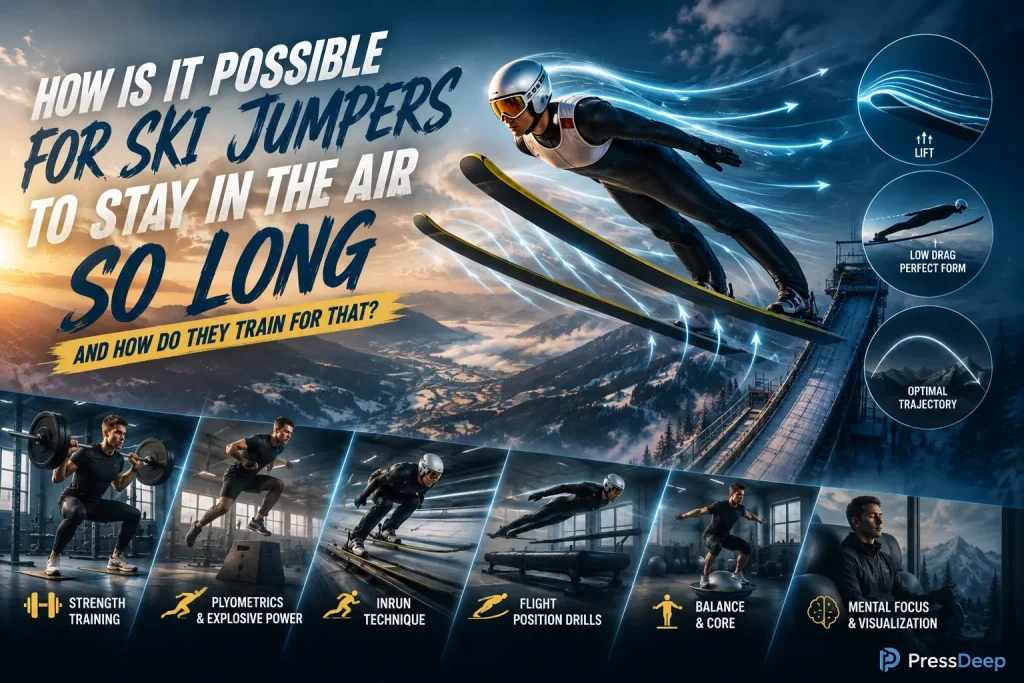
Watching a ski jumper launch from a steep ramp can make it look as if they are somehow floating. After leaving the takeoff table, elite jumpers can remain airborne for several seconds while traveling well over 100 meters before touching the snow again.
So, how is it possible for ski jumpers to stay in the air so long and how do they train for that?
The answer comes down to a combination of physics, body position, specialized skis, speed, aerodynamic technique, timing, and years of highly specific training. Ski jumpers are not simply falling from a high ramp. They are actively using airflow around their bodies and skis to generate lift while minimizing drag.
Understanding the sport becomes much easier once you look at what happens during each stage of a ski jump.
Why Ski Jumpers Can Stay in the Air for So Long
A ski jumper stays airborne because several forces act on the athlete after takeoff.
The most important are:
- Gravity
- Lift
- Drag
- Forward momentum
- Air resistance
- The aerodynamic shape created by the body and skis
Gravity constantly pulls the jumper toward the ground. However, the jumper enters the air at high speed and positions the skis and body so that moving air creates lift.
The goal is not to completely overcome gravity. Instead, the jumper tries to slow the rate at which gravity brings them back toward the slope.
Ski Jumping Is Controlled Gliding, Not Simple Falling
A person jumping straight off a platform would quickly fall downward.
A ski jumper behaves differently.
Before takeoff, the athlete travels down the inrun at high speed. That speed creates significant airflow once the jumper leaves the ramp.
The jumper then turns the skis and body into aerodynamic surfaces.
Instead of dropping almost vertically, the athlete follows a long forward and downward flight path.
This is why ski jumping is more accurately understood as a short form of controlled gliding.
The Physics Behind a Ski Jumper’s Flight
Four major physical factors determine how long a ski jumper can remain airborne.
Gravity
Gravity pulls every jumper toward Earth.
No technique can eliminate gravity, but good ski jumping technique allows the athlete to produce enough aerodynamic lift to descend more gradually.
The slower the downward acceleration appears relative to the jumper’s forward movement, the longer and farther the flight can become.
Lift
Lift is one of the biggest reasons ski jumpers can travel such impressive distances.
When air flows around the skis and body, differences in airflow and pressure can create an upward aerodynamic force.
The skis essentially function like narrow wings.
Modern jumpers spread their skis into a V-shaped position, increasing the effective surface area interacting with the air.
More effective lift means the athlete can remain above the slope longer.
Drag
Drag is the aerodynamic resistance created as the jumper moves through the air.
Some drag is unavoidable.
Too much drag slows the jumper’s forward speed, which reduces the ability to generate lift.
This is why jumpers maintain an extremely streamlined body position.
They try to maximize useful lift while minimizing unnecessary drag.
Forward Speed
Speed is essential.
The faster air moves around the skis and body, the greater the potential aerodynamic forces.
Ski jumpers therefore spend much of the approach trying to preserve as much speed as possible before reaching the takeoff point.
Even small mistakes during the inrun can reduce speed enough to affect the final distance.
Why the V-Style Makes Such a Big Difference
One of the most recognizable features of modern ski jumping is the V-shaped ski position.
Instead of holding both skis parallel, jumpers spread the tips of their skis apart while keeping the tails closer together.
This technique became dominant because it significantly improves aerodynamic performance.
The V-position can:
- Increase the effective lifting surface
- Improve airflow around the skis
- Create greater lift
- Improve stability
- Allow longer flight distances
The skier’s body becomes part of the aerodynamic system as well.
The athlete leans forward with the torso positioned close to the skis, creating a relatively flat shape that interacts efficiently with the air.
How Body Position Helps Ski Jumpers Fly Farther
A ski jumper’s body position during flight is extremely precise.
The typical position includes:
- Head facing forward
- Torso leaning toward the skis
- Hips extended
- Arms held close to the body or slightly behind
- Skis spread into a V
- Ankles carefully controlled
- Minimal unnecessary movement
Even small changes can affect airflow.
If the jumper lifts the upper body too much, drag increases.
If the skis are positioned incorrectly, lift and stability may decrease.
Elite jumpers therefore develop extraordinary body awareness.
How Fast Do Ski Jumpers Travel?
Ski jumpers can reach very high speeds during the inrun before takeoff.
The exact speed depends on the hill, conditions, gate position, athlete, and competition setup, but speeds around 80 to 100 kilometers per hour are common on large jumping hills.
That speed provides the forward momentum necessary for the flight phase.
Importantly, the jumper does not simply try to go as fast as possible.
The entire approach must remain controlled.
A poor body position can create extra drag and reduce speed before the athlete even leaves the ramp.
What Happens During Takeoff?
Takeoff is one of the most technically demanding moments of a ski jump.
The athlete reaches the end of the ramp while moving at high speed and performs a powerful but carefully timed extension.
The jumper must generate upward and forward force without making an exaggerated jumping motion.
Timing is critical.
If the athlete takes off too early, valuable energy can be lost.
If the athlete is late, the jumper may leave the ramp at a poor angle.
A successful takeoff allows the jumper to transition smoothly into the flight position.
Why Ski Jumpers Do Not Jump Straight Up
Someone unfamiliar with the sport might assume that ski jumpers try to leap as high as possible.
They do not.
A very high vertical jump would waste forward momentum and may create poor aerodynamics.
Instead, jumpers focus on explosive extension that matches the angle and timing of the ramp.
The objective is to enter the airflow efficiently rather than simply gaining height.
How Do Ski Jumpers Train for Long Flights?

Ski jumpers train far more than the actual jump itself.
Their programs combine strength, explosive power, balance, coordination, flexibility, technical practice, and mental preparation.
The training is designed to make every stage of the jump repeatable.
Explosive Leg Strength Training
Takeoff happens extremely quickly.
Ski jumpers therefore need powerful legs capable of generating force in a fraction of a second.
Common training methods may include:
- Squats
- Jump squats
- Box jumps
- Bounding exercises
- Hurdle jumps
- Plyometric drills
- Single-leg exercises
- Olympic-style lifting variations
The goal is usually not to build the largest muscles possible.
Ski jumpers benefit from high power relative to body weight.
They need to produce force without carrying unnecessary mass.
Plyometric Training
Plyometric exercises are particularly valuable because they train the muscles to produce explosive force quickly.
Examples include:
- Depth jumps
- Repeated jumps
- Broad jumps
- Hops
- Bounding
- Reactive jump drills
These exercises help develop the fast extension needed during takeoff.
The athlete must be able to create power almost instantly.
Balance and Stability Training
Imagine trying to maintain a precise aerodynamic position while traveling through the air at high speed.
That requires exceptional balance.
Ski jumpers use various exercises to improve stability, including:
- Balance boards
- Single-leg drills
- Core exercises
- Unstable-surface training
- Landing drills
- Coordination exercises
Good balance helps athletes control their skis and body throughout the flight.
Core Strength
The core connects the upper and lower body.
During flight, the athlete must maintain a rigid yet controlled aerodynamic posture.
Strong abdominal, lower-back, hip, and trunk muscles help prevent unwanted movement.
Core training may include:
- Planks
- Side planks
- Anti-rotation exercises
- Hanging leg exercises
- Stability exercises
- Controlled trunk movements
The objective is not simply abdominal strength.
The jumper needs complete control of the torso.
Aerodynamic Position Training
One of the most unusual parts of ski jumping training is practicing the flight position away from the hill.
Athletes may rehearse body angles repeatedly until they become automatic.
Coaches analyze details such as:
- Torso angle
- Hip position
- Ski angle
- Hand position
- Head position
- Symmetry
- Timing of the transition after takeoff
At elite levels, tiny changes can significantly influence performance.
Wind Tunnel Training
Some ski jumping programs use wind tunnels to study and improve aerodynamic positioning.
Inside a wind tunnel, athletes can experience controlled airflow without performing an actual ski jump.
Coaches can experiment with different body and ski positions and observe how those adjustments influence lift and stability.
Wind tunnel training can help athletes understand exactly how small movements affect aerodynamic performance.
Summer Ski Jump Training
Ski jumpers do not necessarily have to wait for snow.
Many ski jumping facilities allow athletes to train during warmer months.
The inrun may use artificial tracks, while the landing area can be covered with specially designed plastic material.
This allows athletes to perform real jumps throughout much of the year.
Summer training helps jumpers maintain technical consistency.
Landing Practice
Flying far is only part of the event.
The jumper also needs to land safely and correctly.
Ski jumpers commonly use a landing technique known as the Telemark position.
During a Telemark landing:
- One ski moves slightly ahead of the other
- The knees bend
- The body remains balanced
- The arms help stabilize the athlete
Judges consider landing quality when awarding style points.
Landing drills are therefore an important part of training.
Reaction and Coordination Training
Ski jumping requires precise timing.
At high speed, the athlete has very little time to react at takeoff.
Training often includes exercises designed to improve:
- Reaction speed
- Rhythm
- Coordination
- Timing
- Spatial awareness
These skills help the jumper perform the same movement pattern consistently.
Flexibility and Mobility Training
Jumpers need sufficient flexibility to achieve an aerodynamic flight position without losing control.
Important areas include:
- Ankles
- Hips
- Hamstrings
- Lower back
- Shoulders
Mobility training also helps athletes maintain proper positions during the inrun, takeoff, flight, and landing phases.
Mental Training
Standing at the top of a ski jumping hill can be intimidating.
Athletes need confidence and concentration because hesitation can disrupt timing.
Mental preparation may involve:
- Visualization
- Breathing techniques
- Pre-jump routines
- Focus exercises
- Competition simulations
Many athletes mentally rehearse the entire jump before starting down the ramp.
The Four Main Phases of a Ski Jump
A successful ski jump can be divided into four major phases.
| Phase | Main Objective | Important Skill |
|---|---|---|
| Inrun | Build and preserve speed | Aerodynamic tuck |
| Takeoff | Generate controlled explosive force | Timing and leg power |
| Flight | Maximize lift and minimize drag | V-style and body position |
| Landing | Finish safely and smoothly | Balance and Telemark technique |
Each phase affects the next one.
A mistake during the inrun can reduce takeoff speed. A poor takeoff can make it difficult to establish an effective flight position. A poor flight position can reduce distance.
This is why ski jumpers spend years refining every part of the sequence.
Why Ski Jumpers Crouch Before Takeoff
During the approach, ski jumpers usually adopt a deep aerodynamic tuck.
The position reduces frontal surface area and therefore helps lower air resistance.
The athlete tries to keep the body compact while maintaining enough tension to prepare for takeoff.
The tuck also positions the legs for the explosive extension that occurs near the end of the ramp.
Does a Ski Jumper’s Weight Affect Flight?
Body weight can influence ski jumping performance because the sport involves the relationship between gravity, lift, ski size, and aerodynamic efficiency.
However, modern ski jumping uses equipment and competition regulations intended to discourage athletes from becoming excessively light simply to gain an aerodynamic advantage.
Performance therefore depends on much more than body weight.
Strength, technique, equipment, speed, timing, and weather conditions all matter.
Why Are Ski Jumping Skis So Long?
Ski jumping skis are significantly longer than ordinary alpine skis.
Their large surface area helps interact with airflow and produce lift.
During flight, the skis effectively act as aerodynamic surfaces.
Longer skis can provide greater lifting potential, but equipment dimensions are regulated to maintain fairness and athlete safety.
Why Do Ski Jumpers Wear Tight Suits?
Ski jumping suits are designed with aerodynamics in mind.
Loose clothing could create unpredictable airflow and excessive drag.
Competition suits are therefore carefully regulated.
The fit, fabric, thickness, and dimensions must comply with sport rules because even relatively small aerodynamic differences can influence performance.
How Wind Affects Ski Jumping
Wind can have a major effect on a ski jump.
A headwind can sometimes increase aerodynamic lift because more air flows against the jumper’s skis and body.
A tailwind may reduce that advantage.
However, strong or inconsistent wind can also make jumping dangerous and unpredictable.
Competition officials monitor conditions closely, and scoring systems may include wind compensation to account for changing conditions.
Does a Ski Jumper Actually Feel Like They Are Flying?
From a physics perspective, ski jumpers are following a descending trajectory rather than flying indefinitely like an airplane.
However, the aerodynamic lift generated by their skis and body significantly changes the shape of that trajectory.
Instead of quickly falling toward the ground, they glide forward while gradually descending toward the landing hill.
Because the landing slope falls away beneath them, the athlete can travel a remarkable horizontal distance before making contact with the snow.
Why the Shape of the Hill Matters
The design of the ski jumping hill is another reason the flight can look unusually long.
The landing area slopes steeply downward.
As the jumper descends, the ground is also dropping away.
This means the athlete does not need to remain at the same absolute height for several seconds.
The jumper is descending throughout much of the flight, but the slope beneath them is descending too.
This creates the dramatic appearance of extended flight.
Ski Jumping vs Normal Jumping
| Feature | Normal Jump | Ski Jump |
|---|---|---|
| Starting speed | Usually low | Very high |
| Equipment | None | Long aerodynamic skis |
| Main motion | Mostly vertical and downward | Forward gliding trajectory |
| Aerodynamic lift | Minimal | Significant |
| Body position | Usually upright | Carefully streamlined |
| Flight distance | Short | Can exceed 100 meters |
| Training focus | General jumping ability | Power, aerodynamics, timing, balance |
The biggest difference is that ski jumping transforms forward speed into an aerodynamic glide.
How Long Are Ski Jumpers Actually in the Air?
The exact flight time depends on the size of the hill, jump distance, speed, wind, and trajectory.
Although the jump may appear to last much longer when watched on television or in slow motion, a typical elite ski jump keeps the athlete airborne for only several seconds.
Those few seconds are enough to travel an extraordinary distance because the jumper is moving forward at high speed.
How Long Does It Take to Become a Skilled Ski Jumper?

Ski jumping requires years of technical development.
Most elite athletes begin learning the sport when they are young and gradually progress from smaller hills to larger ones.
Beginners typically learn:
- Basic skiing control
- Inrun posture
- Small-hill takeoffs
- Flight positioning
- Landing technique
- Larger-hill jumping
Progress is carefully controlled because mistakes become increasingly serious as speed and hill size increase.
Can Ordinary Skiers Try Ski Jumping?
Ski jumping is a specialized sport and should not be attempted on professional jumping hills without proper training.
Recreational skiing skills alone are not enough.
Beginner ski jumpers normally learn under qualified coaching and start on small training hills designed for controlled progression.
The technique differs greatly from ordinary downhill skiing.
What Makes an Elite Ski Jumper Successful?
Top ski jumpers combine several abilities rather than relying on one exceptional skill.
A successful athlete typically needs:
- High power-to-weight ratio
- Explosive leg strength
- Excellent balance
- Precise timing
- Strong aerodynamic awareness
- Good flexibility
- Consistent technique
- Mental confidence
- Fast reactions
- Excellent landing control
The best performers repeat these skills with remarkable precision.
Frequently Asked Questions
How do ski jumpers stay in the air for so long?
Ski jumpers stay airborne by combining high forward speed with aerodynamic lift generated by their long skis and carefully controlled body position. The V-shaped ski technique increases effective surface area and helps the jumper glide rather than simply fall.
Are ski jumpers actually flying?
They are technically gliding through the air while descending. Aerodynamic lift slows their downward motion, allowing them to travel a long horizontal distance before reaching the landing slope.
Why do ski jumpers spread their skis apart?
The V-shaped position creates better aerodynamic lift than keeping the skis completely parallel. It also helps improve stability during flight.
How do ski jumpers train?
Training includes explosive leg exercises, plyometrics, balance work, core strengthening, technical drills, aerodynamic-position practice, landing training, flexibility exercises, and mental preparation.
Do ski jumpers practice without snow?
Yes. Many ski jumping facilities have artificial surfaces that allow athletes to train during warmer months. Some athletes also use wind tunnels and specialized dry-land training equipment.
Why don’t ski jumpers jump straight upward?
Jumping too vertically would waste forward speed. Ski jumpers use a precisely timed extension that helps them transition smoothly from the ramp into an aerodynamic flight position.
Why are ski jumping skis longer than normal skis?
The additional surface area helps the skis generate aerodynamic lift. Their size and dimensions are regulated in competitive ski jumping.
Does wind help ski jumpers?
Certain headwinds can increase lift, while tailwinds may reduce it. However, strong or unstable winds can also make jumping difficult or unsafe.
Is ski jumping mostly strength or technique?
Both matter, but technique is extremely important. A powerful athlete with poor timing or aerodynamics may lose significant distance, while an efficient jumper can use speed and airflow much more effectively.
Conclusion
So, how is it possible for ski jumpers to stay in the air so long and how do they train for that? The impressive flight comes from the interaction between speed, gravity, aerodynamic lift, long skis, precise body positioning, and the steep shape of the landing hill.
Ski jumpers enter the air with considerable forward momentum and use the V-position to turn their skis into highly effective aerodynamic surfaces. Their streamlined posture reduces unnecessary drag while helping them generate enough lift to descend gradually rather than drop quickly toward the ground.
Behind those few seconds in the air are years of training. Athletes develop explosive leg power, balance, coordination, core strength, flexibility, reaction speed, landing technique, and extremely precise aerodynamic control.
What appears to be effortless floating is actually one of the most technically demanding combinations of physics and athletic skill in winter sports.