Connectivity Issues HSSGamepad: Fix Connection Problems

Connectivity issues HSSGamepad users experience can turn a normal gaming session into a frustrating cycle of pairing attempts, random disconnections, input delays, and controller detection errors. Sometimes the gamepad appears connected but does not respond. In other situations, Bluetooth cannot find the controller at all, or a wired connection stops working unexpectedly.
Fortunately, many gamepad connection problems are caused by relatively simple issues such as low battery power, an incorrect connection mode, an outdated Bluetooth pairing, USB cable problems, wireless interference, or device compatibility conflicts.
The best approach is not to change every setting at once. Start with the simplest possible checks, determine whether the problem affects Bluetooth, USB, or both, and then work through the possible causes one by one.
This guide explains how to troubleshoot connectivity issues HSSGamepad users may encounter and how to create a more stable controller connection across PCs, mobile devices, tablets, and other compatible systems.
What Are Connectivity Issues HSSGamepad Users Experience?
Connectivity issues HSSGamepad generally refers to problems that prevent the controller from establishing or maintaining reliable communication with the device being used for gaming.
The symptoms can vary considerably.
Common problems include:
- HSSGamepad not connecting through Bluetooth
- Controller pairing but not responding
- Bluetooth failing to detect the gamepad
- Gamepad randomly disconnecting
- USB controller not being detected
- Controller working in one game but not another
- Input lag during wireless gameplay
- Buttons responding with noticeable delay
- Gamepad connecting and disconnecting repeatedly
- Controller failing after a system update
- HSSGamepad working on one device but not another
- Wireless connection becoming unstable at longer distances
Identifying the exact symptom is important because a controller that cannot pair requires different troubleshooting from a controller that pairs successfully but produces delayed input.
Quick HSSGamepad Troubleshooting Table
| Problem | Possible Cause | First Thing to Try |
|---|---|---|
| HSSGamepad not connecting | Pairing or compatibility issue | Remove old pairing and reconnect |
| Bluetooth cannot find controller | Controller not in pairing mode | Restart pairing mode |
| Random disconnections | Low battery or interference | Charge controller and move closer |
| USB gamepad not detected | Cable or USB port issue | Try another data-capable cable and port |
| Controller connected but not working | Wrong input mode or game configuration | Check controller mode and game settings |
| Severe input lag | Wireless interference or distance | Reduce distance and nearby wireless activity |
| Works on phone but not PC | Driver or compatibility issue | Update system and controller-related drivers |
| Stops working after update | Driver or software conflict | Restart, reconnect, and reinstall affected device drivers |
| Connection drops after a few minutes | Battery, power management, or interference | Fully charge and check power-saving settings |
| Works through USB but not Bluetooth | Bluetooth-side problem | Remove pairing and troubleshoot Bluetooth adapter |
Start With the Basic Checks
Before changing drivers or resetting anything, perform a few basic checks. These simple steps can solve more problems than complicated troubleshooting.
Fully Charge the Controller
A gamepad may still power on even when its remaining battery is insufficient for consistently stable wireless communication.
Charge the controller fully before testing Bluetooth again.
After charging:
- Turn the controller completely off.
- Restart the device you are connecting it to.
- Turn the controller back on.
- Activate the appropriate pairing mode.
- Attempt a fresh connection.
If the controller works normally after charging, the issue was probably related to power rather than Bluetooth configuration.
Restart Both Devices
Temporary Bluetooth, USB, or operating system processes sometimes stop responding correctly.
Restart:
- The HSSGamepad
- PC, smartphone, tablet, or other host device
Then attempt the connection again before changing additional settings.
Move the Controller Closer
Test the controller relatively close to the receiving device.
If it works reliably nearby but becomes unstable farther away, the problem is more likely related to signal quality, obstacles, or wireless interference rather than the controller’s basic pairing configuration.
Fix HSSGamepad Bluetooth Pairing Problems
Bluetooth pairing problems are among the most common wireless controller complaints.
If your HSSGamepad is not appearing in the Bluetooth device list, appears but refuses to connect, or repeatedly asks to pair again, create a completely fresh connection.
Remove the Existing Bluetooth Pairing
An old saved pairing can sometimes become corrupted or conflict with a previous connection.
Open your device’s Bluetooth settings and locate the controller.
Choose the appropriate option to:
- Forget device
- Remove device
- Unpair
Turn Bluetooth off briefly and switch it back on.
Restart the controller, activate pairing mode again, and search for nearby devices.
This creates a new Bluetooth relationship instead of repeatedly attempting to use an existing configuration.
Disconnect Other Previously Paired Devices
If the gamepad has previously been connected to another PC, phone, tablet, or compatible gaming device, it may attempt to reconnect to that device automatically.
Temporarily disable Bluetooth on the other devices while pairing the controller to your preferred system.
This is particularly useful when an HSSGamepad appears to turn on normally but is missing from the Bluetooth scan on a new device.
Confirm That Pairing Mode Is Actually Active
Turning a wireless controller on is not always the same as placing it into pairing mode.
Controllers often use an LED pattern to indicate whether they are:
- Powered on
- Searching for a previously paired device
- Ready for a new pairing
- Successfully connected
The precise button combination and LED behavior can vary by controller version, so use the instructions supplied with your particular model rather than assuming that every HSSGamepad variant uses the same pairing sequence.
HSSGamepad Keeps Disconnecting Randomly
A controller that connects successfully but disconnects during gameplay requires a different approach.
The connection has already been established, so the focus should shift to stability.
Check Battery Level
Start with battery power.
Wireless controllers can behave unpredictably as their battery gets low. Instead of immediately shutting down, the gamepad may disconnect, reconnect, or begin responding inconsistently.
Charge it fully and repeat the same gaming session.
Reduce Wireless Interference
Bluetooth operates in a busy wireless environment.
Nearby equipment can increase congestion, including:
- Wi-Fi equipment
- Wireless headsets
- Bluetooth speakers
- Wireless keyboards and mice
- Multiple connected controllers
- Other Bluetooth accessories
You do not necessarily need to permanently disable these devices. Temporarily removing some of them can help determine whether interference is contributing to the problem.
Remove Physical Obstacles
A controller usually works best when there are fewer major obstacles between it and its receiving device or Bluetooth adapter.
If a desktop PC is under a desk, against a wall, or surrounded by metal equipment, Bluetooth reception may be weaker than expected.
Try changing the position of the host device or Bluetooth adapter and test again.
Fix HSSGamepad USB Connection Problems
If Bluetooth is not the problem and the controller is being used through USB, troubleshoot the wired connection separately.
Make Sure the USB Cable Supports Data
One easily overlooked issue is the USB cable itself.
Some cables are intended primarily for charging and may not reliably carry the data required for controller communication.
A controller can therefore appear to be charging while the computer does not recognize it as an input device.
Try another known data-capable USB cable.
Test Another USB Port
Connect the HSSGamepad directly to a different USB port.
If possible, avoid:
- Damaged or loose ports
- Unreliable USB extensions
- Unpowered hubs
- Worn connectors
If the controller works in one port but not another, the gamepad itself may not be the source of the problem.
Connect Directly to the Computer
When troubleshooting, simplify the connection.
Instead of using:
Controller → USB hub → extension → PC
test:
Controller → PC
Removing unnecessary equipment helps isolate where the failure begins.
HSSGamepad Connected but Not Working in Games
Sometimes Windows or another system recognizes the controller successfully, yet nothing happens inside the game.
This is no longer purely a connectivity problem.
The issue may involve controller input mode, game configuration, launcher settings, or compatibility.
Check Whether the System Detects Input
Determine whether button presses and joystick movements are recognized by the operating system.
If the controller responds correctly at the system level but not inside one particular game, the problem is more likely related to that game’s controller configuration.
If the system itself receives no input, continue troubleshooting the controller connection or drivers.
Check the Game’s Controller Settings
Open the game’s control or input menu.
Confirm that:
- Controller input is enabled
- The correct controller is selected
- Another connected controller is not taking priority
- Controls are properly mapped
- Keyboard-only mode is not active
Restart the game after connecting the controller because some games only detect controllers during startup.
XInput and DInput Compatibility Problems
PC controllers can communicate through different input standards.
Two commonly encountered modes are XInput and DirectInput, often shortened to DInput.
Modern Windows games commonly provide strong XInput support, while some older titles, emulators, applications, or specialized configurations may behave differently.
If your specific HSSGamepad model provides multiple input modes, connecting successfully does not automatically mean that the currently selected mode is appropriate for the software you are using.
Symptoms of an incorrect input mode can include:
- Controller detected but buttons do nothing
- Incorrect button mapping
- Triggers behaving strangely
- Some buttons missing
- Game refusing to recognize the controller
- Controller functioning in one application but not another
Check your model’s documentation before changing modes because the required button combination varies between controllers.
Update Bluetooth and USB Drivers on Windows
If HSSGamepad connectivity problems occur primarily on a Windows PC, device drivers deserve attention.
Check Bluetooth Drivers
Open Device Manager and inspect the Bluetooth section.
Look for:
- Warning symbols
- Disabled devices
- Unknown devices
- Bluetooth adapters with reported errors
Windows can often update the driver automatically, although systems using specialized Bluetooth hardware may work better with drivers supplied by the computer or adapter manufacturer.
Reinstall a Problematic Bluetooth Device
When a Bluetooth adapter behaves incorrectly even after restarting:
- Open Device Manager.
- Locate the Bluetooth adapter.
- Remove or uninstall the affected device when appropriate.
- Restart Windows.
- Allow Windows to detect the hardware again.
- Re-pair the controller.
Avoid randomly uninstalling unfamiliar system components. Only change the device that you have identified as part of the Bluetooth connection.
Check Windows Power Management
A less obvious cause of repeated wireless or USB disconnections is power management.
Laptops in particular may attempt to reduce power consumption by suspending certain USB or wireless components.
If your controller works normally at first and disconnects after a period of inactivity or during longer sessions, review the relevant Windows power settings.
Power-saving settings are especially worth investigating when:
- The controller disconnects after similar amounts of time
- USB devices also occasionally disappear
- Problems mainly occur on battery power
- The issue began after changing a power profile
Firmware and Software Compatibility
Firmware acts as internal software for many modern controllers.
A firmware problem can potentially affect:
- Pairing
- Device recognition
- Button mapping
- Wireless stability
- Compatibility with newer operating systems
However, avoid installing firmware from unofficial or unrelated sources simply because the name of the controller appears similar.
Controller revisions can use different hardware internally.
Only install firmware when you can confirm that it is intended for your exact device model or revision.
Fix HSSGamepad Input Lag
Connectivity issues do not always cause complete disconnection.
Sometimes the gamepad remains connected while button presses or joystick movements feel delayed.
Compare Wired and Wireless Performance
One useful diagnostic test is comparing Bluetooth and USB.
If input feels responsive over USB but noticeably delayed wirelessly, investigate:
- Bluetooth interference
- Distance
- Bluetooth adapter quality
- Battery condition
- Other connected wireless devices
If the delay remains almost identical through both connection types, the problem may instead involve the game, computer performance, display latency, or controller configuration.
Close Unnecessary Background Applications
High system load can sometimes make controller input feel inconsistent even when the wireless connection itself is stable.
Close unnecessary applications and test the same game again.
This is particularly useful on systems already experiencing:
- CPU spikes
- Memory pressure
- Game stuttering
- Background updates
- Heavy recording or streaming workloads
Bluetooth vs USB vs Wireless Dongle
Not every HSSGamepad model necessarily includes every connection option, but understanding the differences can make troubleshooting easier.
| Connection Type | Main Advantage | Common Problems | Best Troubleshooting Method |
|---|---|---|---|
| Bluetooth | Convenient wireless use | Pairing, interference, battery, adapter issues | Forget device and pair again |
| USB | Stable direct connection | Cable, port, driver problems | Change cable and USB port |
| 2.4 GHz dongle, if supported | Dedicated wireless connection | Receiver pairing, interference, USB issues | Reconnect receiver and test another port |
A wired test can be particularly useful even if you prefer wireless gaming because it helps separate controller hardware or software problems from radio-related issues.
How to Diagnose the Real Source of the Problem
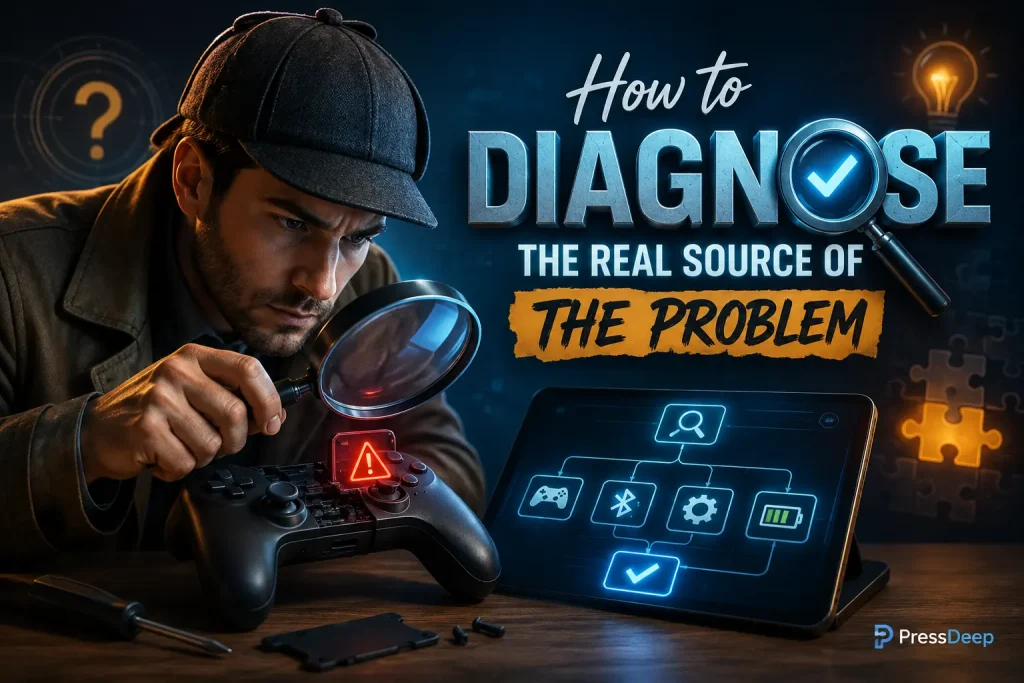
Instead of repeatedly reconnecting the controller to the same device, perform a simple isolation test.
Test the HSSGamepad on Another Device
Try another compatible PC, phone, tablet, or device.
If the controller works normally elsewhere, the original host device probably has:
- Bluetooth problems
- Driver conflicts
- Software configuration issues
- USB problems
- Compatibility limitations
If the same problem occurs across several devices, the controller itself becomes a stronger suspect.
Test Another Controller on the Same Device
If another compatible controller works perfectly on the same PC or mobile device, the Bluetooth or USB system is probably functioning.
That narrows the issue toward the HSSGamepad, its configuration, its battery, or its compatibility with that particular setup.
A Better Troubleshooting Order
Randomly changing settings can create additional problems. Use this sequence instead.
- Fully charge the controller.
- Restart both the HSSGamepad and host device.
- Confirm the correct connection or pairing mode.
- Remove the existing Bluetooth pairing.
- Pair the controller again.
- Disable nearby previously paired devices temporarily.
- Move closer and reduce wireless interference.
- Test another USB cable if wired mode is available.
- Test another USB port.
- Check whether the operating system recognizes controller input.
- Verify the game’s controller settings.
- Check the appropriate input mode if your model supports multiple modes.
- Update relevant operating system and Bluetooth drivers.
- Use compatible firmware only when available for the exact model.
- Test the gamepad on another device.
Following a consistent sequence makes it easier to identify the actual cause instead of temporarily hiding it.
How to Prevent Future HSSGamepad Connection Problems
A few habits can reduce repeated connection issues.
Keep the Battery Charged
Do not wait until the controller repeatedly disconnects before charging it.
Maintaining a reasonable charge level makes troubleshooting easier because battery instability can immediately be ruled out.
Avoid Constantly Pairing With Many Devices
Frequently switching a controller between PCs, phones, tablets, and other systems can create confusion about which device it should reconnect to.
Remove unused pairings when necessary.
Protect USB Cables and Ports
Repeatedly bending cables near the connector can cause internal damage that may not be immediately visible.
Replace cables showing:
- Loose connectors
- Exposed wiring
- Sharp bends
- Intermittent charging
- Connection loss when moved
Keep Your System Updated
Operating system and Bluetooth updates can improve compatibility and fix device recognition problems.
At the same time, if connectivity suddenly fails immediately after an update, consider whether the new software or driver could be involved.
When Is the HSSGamepad Probably Faulty?
Not every connectivity problem is software-related.
Hardware failure becomes more likely when:
- The controller cannot connect to multiple known-compatible devices
- Several good USB cables fail
- Multiple USB ports produce the same result
- Bluetooth and wired modes both fail
- The controller repeatedly powers off despite being charged
- The charging port is physically loose
- The controller only works when the cable is held at a particular angle
- Visible physical or liquid damage exists
- Connection problems continue after a complete troubleshooting process
Testing the controller across multiple devices is one of the most useful ways to separate a controller fault from a host-device problem.
Common Mistakes When Troubleshooting Connectivity Issues HSSGamepad
Some troubleshooting methods actually make diagnosis harder.
Changing Too Many Settings at Once
If you reinstall drivers, reset Bluetooth, change controller mode, update software, and alter game settings simultaneously, you will not know which step fixed or caused the problem.
Change one major variable at a time.
Assuming Connected Means Compatible
A device appearing in the Bluetooth list does not guarantee full compatibility with every game.
Bluetooth connection and game-level controller support are separate things.
Using Random Firmware
Installing firmware intended for a similar-looking controller can potentially create additional problems.
Match firmware to the exact device.
Assuming Charging Means USB Data Works
A USB cable can deliver electrical power without properly transferring controller data.
This is why trying another known data cable is an important wired troubleshooting step.
Replacing the Controller Too Early
A faulty cable, Bluetooth driver, incorrect game setting, or stale pairing can make a perfectly usable gamepad appear defective.
Test the controller on another device before deciding that replacement is necessary.
Frequently Asked Questions
Why is my HSSGamepad not connecting?
An HSSGamepad may fail to connect because of an old Bluetooth pairing, incorrect pairing mode, low battery, wireless interference, USB cable issues, driver problems, compatibility limitations, or an incorrect controller input mode. Start by charging and restarting the controller, then remove the existing pairing and connect it again.
Why does my HSSGamepad keep disconnecting?
Repeated disconnections can be related to low battery power, wireless interference, distance, Bluetooth adapter issues, power-saving settings, damaged USB cables, or unstable ports. Test the controller close to the host device and compare Bluetooth performance with a wired connection when possible.
Why is HSSGamepad connected but not working?
If the controller appears connected but produces no input, check whether the operating system detects button presses. If it does, review the game’s controller settings and input mode. If the operating system receives no input, troubleshoot the connection, drivers, cable, and controller mode.
How do I fix HSSGamepad Bluetooth pairing problems?
Remove the saved controller from your Bluetooth device list, restart Bluetooth, restart the controller, activate the proper pairing mode, and connect again. Temporarily disable Bluetooth on other devices previously paired with the gamepad.
Why is my USB gamepad charging but not working?
The USB cable may provide power but lack reliable data transfer. Replace it with a known data-capable cable and connect directly to another USB port.
Can Wi-Fi interfere with a Bluetooth gamepad?
Bluetooth and some Wi-Fi equipment operate in the same general 2.4 GHz wireless environment. A crowded wireless setup can contribute to unstable Bluetooth performance. Moving closer to the receiving device and temporarily reducing nearby wireless activity can help identify interference.
Why does my HSSGamepad work on one game but not another?
Different games provide different controller support. The affected game may require controller input to be enabled, a different input mode, manual button mapping, or a restart after the gamepad is connected.
Why does HSSGamepad work through USB but not Bluetooth?
This usually indicates that the controller itself can communicate with the device but something is wrong specifically with the wireless connection. Check Bluetooth pairing, adapter drivers, battery level, signal interference, and previously saved pairings.
Should I reset my HSSGamepad?
A reset can be useful after basic troubleshooting fails, but the reset procedure may vary by model. Check the instructions for your particular controller before performing a factory or hardware reset.
How can I tell whether the controller or PC is causing the problem?
Connect the HSSGamepad to another compatible device. Then test another controller on the original PC. If HSSGamepad fails everywhere, the controller may be responsible. If it only fails on one computer, investigate that computer’s Bluetooth, USB, drivers, game settings, or compatibility.
Does HSSGamepad need drivers?
Many modern controllers can use operating-system-provided input drivers, while other models or special features may require additional software. The exact requirements depend on the controller model and operating system.
Can an outdated Bluetooth driver cause gamepad problems?
Yes. A damaged, incompatible, or outdated Bluetooth adapter driver can prevent controllers from pairing correctly or maintaining a reliable connection. Driver troubleshooting is particularly relevant when multiple Bluetooth devices are behaving abnormally on the same PC.
Conclusion
Connectivity issues HSSGamepad users encounter should be diagnosed systematically rather than treated as an immediate hardware failure. A controller that will not pair, repeatedly disconnects, shows input lag, or fails to work through USB can be affected by anything from battery level and old Bluetooth pairings to cables, drivers, wireless interference, game configuration, or compatibility.
Begin with the basics: charge the controller, restart both devices, create a fresh pairing, and test another cable or USB port. Then determine whether the issue occurs across multiple devices and connection methods.
That process is valuable because it separates a genuine HSSGamepad hardware problem from a Bluetooth, USB, software, or game-specific issue. Once the real source is identified, restoring a stable connection is usually much simpler than repeatedly changing settings without knowing what is actually wrong.